AlphaTheta has introduced the DJM-A7, a new 4-channel DJ mixer designed to bring a modern professional workflow into smaller clubs, bars, event spaces, home setups and mobile DJ rigs.
But there are already plenty of excellent DJ mixers available. The flagship DJM-A9 is still a serious club standard, the newer DJM-V5 introduced a compact creative workflow earlier in 2026, and the DJM-750MK2 has been a familiar 4-channel option for years.
So where does the DJM-A7 fit, what is actually new, and why should you care?

A Compact Mixer With DJM-A9 DNA
The easiest way to understand the DJM-A7 is to look at where it comes from.
The DJM-A7 inherits much of its basic channel layout and workflow from the larger DJM-A9. You still get four channels, 3-band EQ, channel faders, Sound Color FX, Beat FX and a familiar club-oriented control layout.
AlphaTheta has also carried over the clear, neutral sonic direction of the DJM-A9, with 32-bit A/D and D/A conversion in the main audio signal path.
What changes is the size and feature set.
The A7 is more compact and less expensive than the A9, while introducing several features of its own that are particularly relevant to smaller venues and DJs who regularly move between different setups.
DJM-A7 vs DJM-V5: Two Different Ideas
The recently released DJM-V5 might look like the obvious comparison, but the two mixers actually have quite different personalities.
The DJM-V5 is a compact 3-channel mixer inspired by the DJM-V10. It gives you 4-band EQ, long 60 mm channel faders, Send FX and a workflow designed around longer blends and detailed sound shaping.
The DJM-A7 takes a more traditional 4-channel club-mixer approach.
If you enjoy sculpting multiple layers and treating the mixer almost like an instrument, the V5 may still be the more interesting choice.
If you want a familiar 4-channel DJ workflow that can accommodate many different performers, software platforms and setups, the A7 may make more sense.
Master Texture: Tune the Mixer to the Room
One of the most interesting new features is Master Texture.
Instead of giving you another conventional master EQ, AlphaTheta provides two controls that adjust the overall character of the master output.
- AIR moves between Smoky and Bright.
- LOW-END moves between Smooth and Punchy.
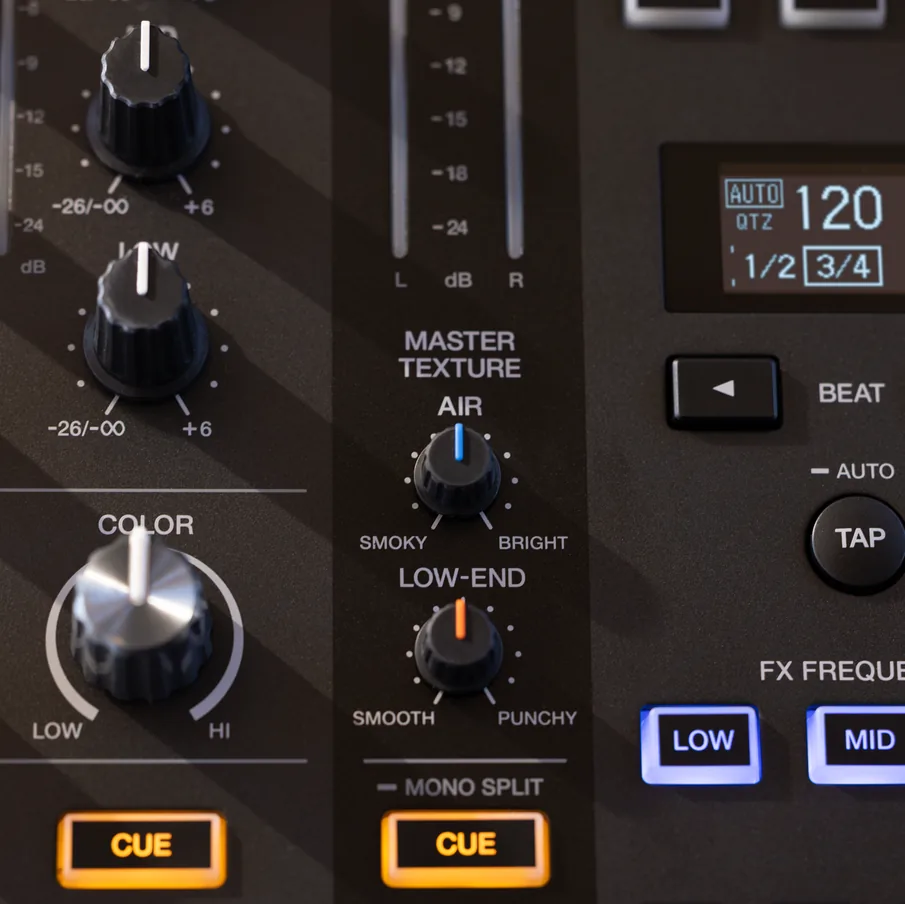
Imagine bringing the same DJ setup into two very different rooms.
One room is bright and reflective, with aggressive high frequencies bouncing around hard surfaces. Moving AIR toward Smoky can help soften the overall character.
Another space may sound loose or muddy in the low end. Moving the LOW-END control toward Punchy can help give the kick and bass more definition.
For DJs working in different venues, or spaces without a dedicated sound engineer, this gives you a quick way to adapt the overall sound to the room.
A New Soft Mix Curve
The DJM-A7 also introduces a Soft Mix Curve option for its channel faders.
As you lower a channel fader, the mixer gently reduces high-frequency content along with the overall level.
This can make transitions between two full-frequency tracks feel softer and less abrupt, especially during longer blends.
It is a subtle feature on paper, but one that could become very useful in practice.
Split Filter: Change the Track Without Losing Its Energy
Another notable addition appears in the Sound Color FX section.
The DJM-A7 includes four Sound Color FX:
- Space
- Dub Echo
- Split Filter
- Filter
The new Split Filter focuses much of its processing on the midrange while allowing more of the highs and lows to remain intact.
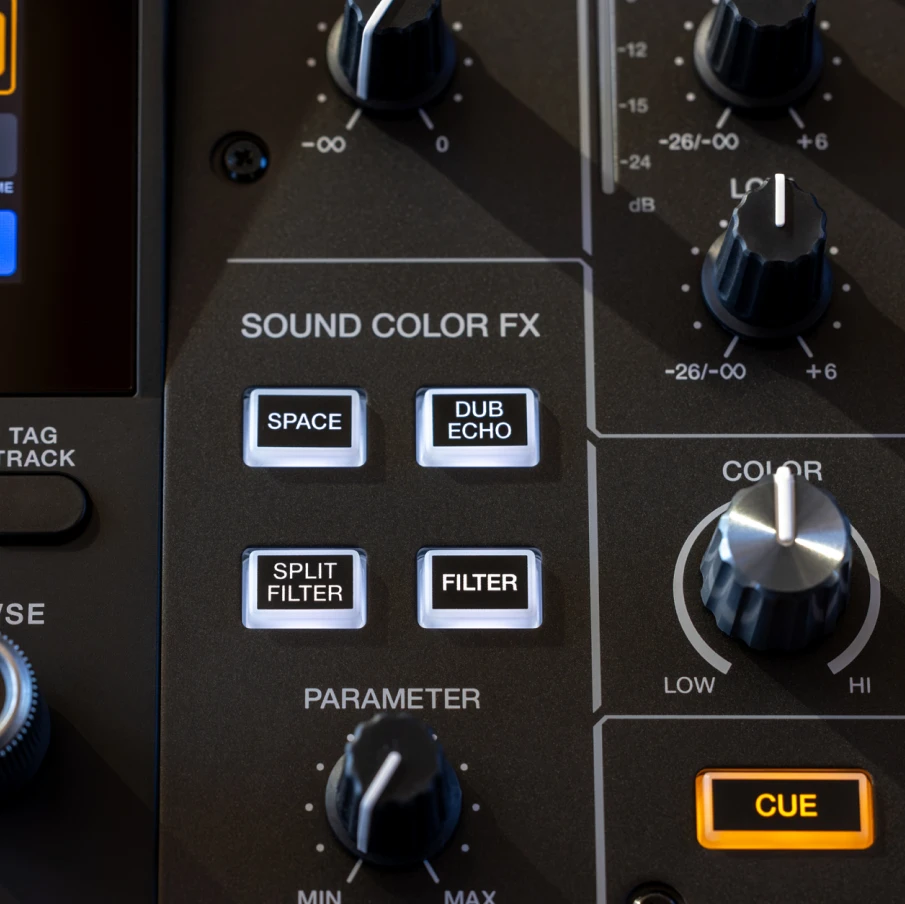
This becomes useful when you want to transform a vocal, synth or midrange element during a transition without completely removing the kick, bass and high-frequency rhythm keeping the track moving.
Instead of filtering the whole mix away, you can create movement while preserving more of its energy.
Beat FX Are Faster to Reach
The Beat FX section has also been simplified.
Instead of scrolling through effects with a rotary selector, the DJM-A7 gives you six illuminated buttons for direct effect selection.
The six Beat FX are Delay, Spiral, Trans, Echo, Reverb and Roll.
There are fewer Beat FX than on the flagship DJM-A9, but the trade-off is immediate access. In a dark booth, you can quickly see which effect is active and choose another without scrolling through a menu.
Dual USB-C Makes DJ Changeovers Easier
This might be one of the least glamorous features on the specification sheet and one of the most useful in a real venue.
The DJM-A7 has two USB Type-C connections, allowing two computers to remain connected simultaneously.
DJ one finishes.
DJ two is already plugged in.
No crawling around the booth trying to change cables while the dance floor waits.
The mixer supports rekordbox, Serato DJ Pro, djay Pro for Mac and Windows, and djay for iOS, making it particularly interesting for venues that regularly host DJs using different systems.
SonicLink Wireless Monitoring
The A7 also includes AlphaTheta's SonicLink wireless monitoring technology.
Compatible headphones can connect with ultra-low latency, and supported models such as the HDJ-F9 can use touch pairing directly from the mixer.
Traditional wired headphone outputs are still available, so wireless monitoring is an additional option rather than a requirement.
What About the DJM-750MK2?
The older DJM-750MK2 remains a perfectly capable mixer.
It has four channels, a familiar Pioneer DJ-style layout, Sound Color FX, Beat FX and a professional signal path. If you already own one and simply need four channels for a home setup, there is no reason to suddenly consider it obsolete.
The differences become much more meaningful if you work with modern multi-DJ setups.
The DJM-A7 adds dual USB-C connections, PRO DJ LINK, Link Cue, SonicLink, modern mobile connectivity, Master Texture, Soft Mix Curve and the new Split Filter.
So the upgrade is not simply about getting a newer version of the same mixer. It is about adapting the mixer to the way modern booths and venues work.
Who Is the DJM-A7 For?
The DJM-A7 makes the most sense for:
- Small and medium-sized clubs
- Bars, restaurants and event spaces
- Mobile DJs
- Rental companies
- DJs who regularly perform back-to-back sets
- Home setups that want a professional 4-channel mixer
- Venues hosting artists using different DJ software
The A7 simply reflects a different DJ environment, one where software changes from artist to artist, quick changeovers matter, booths are often smaller and the same sound system may need to work for several completely different events.
For that kind of space, the A7 starts to make a lot of sense.